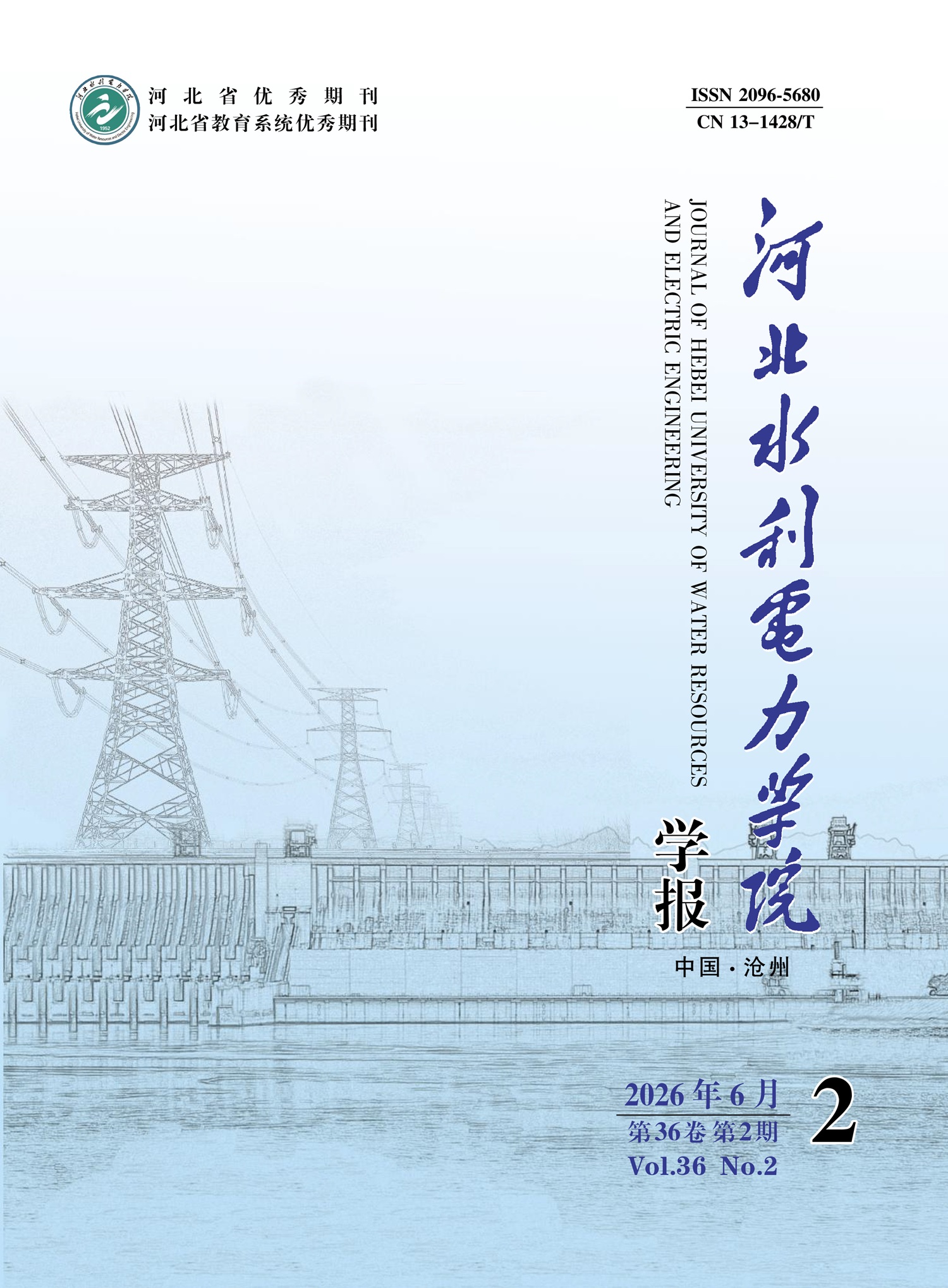
《河北水利电力学院学报》(原《河北工程技术高等专科学校学报》)是河北省教育厅主管,河北水利电力学院主办的国内外公开发行的科技类学术期刊,创刊于1990年1月,季刊,是河北省优秀期刊、河北省教育系统优秀期刊,是河北省评审交通运输工程专业技术资格发表论文指定学术刊物,是《中国核心期刊(遴选)数据库》《中国学术期刊综合评价数据库》的源期刊,是《中国知网》《万方数据库》《中文科技期刊数据库》等全文收录期刊。本刊主要刊载水利、电力、建筑、测绘、电气、交通、机械、计算机等工程技术领域的新理论、新技术、新材料、新工艺、新方法等应用性研究成果,同时也刊载管理科学、基础科学以及新工科教育技术研究等方面的最新研究成果。
30 September 2025, Volume 35 Issue 3 Previous Issue   
For Selected: Toggle Thumbnails

Water Conservancy Engineering and Water Conservancy Informatization
Comprehensive Detection of Anti-abrasion Concrete Structure of Stilling Basin of Water Conservancy Hub
ZHOU Zhenguang, LIU Jin, LIU Kanghe, DUAN Wei
2025, 35(3): 1-7.  DOI: 10.16046/j.cnki.issn2096-5680.2025.03.001
Abstract ( )   PDF (2325KB) ( )  
To comprehensively evaluate the quality of the anti-abrasion concrete structure in the bottom plate of stilling basin of a hydrojunction, we combine geophysical exploration, core drilling, and indoor testing techniques for comprehensive testing. We sequentially complete the positioning, core sampling, recording, panoramic digital imaging of boreholes, and physical and mechanical property testing of core samples, to obtain data on the appearance, wave velocity, density, water absorption, and compressive strength characteristics of concrete structure core samples in a small-invasive manner. Based on design and regulatory requirements, a comprehensive analysis is conducted on all testing data, and the results show that the upper anti-abrasion concrete is unqualified and the bottom concrete meets standards. The application effect of this integrated detection is significant, providing scientific basis for quality assessment and can serve as a reference for similar projects.
References | Related Articles | Metrics
Study on Water Consumption Pattern of Facility Melon under Drip Irrigation Conditions
GONG Aixi, JIA Yongguo, JIA Zhijun, WANG Erying, WANG Huailiang
2025, 35(3): 8-13.  DOI: 10.16046/j.cnki.issn2096-5680.2025.03.002
Abstract ( )   PDF (881KB) ( )  
An irrigation experiment was conducted to study the water consumption pattern of facility cantaloupe under drip irrigation conditions. The lower limits for irrigation were 55%, 70% and 85% of the field water holding capacity respectively, and three water treatments (T1, T2, T3), were repeated three times accordingly. The experimental results showed that under drip irrigation conditions, the water consumption pattern of facility cantaloupe was as follows: from planting to fruit swelling period, the water consumption intensity gradually increased from low to high, and decreased to a certain extent during fruit ripening period; The T2 treatment with an average total irrigation amount of 180mm achieved the highest yield of 27 000 kg/hm2; Through regression analysis of water consumption and yield of facility melon, the optimal water consumption for the entire growth period of cantaloupe in this experiment was 218.47mm. The facility melons required no irrigation from after the second slow-seedling watering at planting untill the pre-flowering and fruiting stage with drip irrigation. After entering the flowering fruiting period, it is advisable to irrigate once a week with a water quota of about 300 m3/(hm2·per application), which can basically meet the water demand of the facility melon. The recommended irrigation quota is 2250 m3/hm2.
References | Related Articles | Metrics
Artificial Intelligence and Robotics
Design of Structure and Control System of Ultrasonic Welding Industrial Robot
ZHOU Lijie, HUANG Fa, CHAI Chunlin, KONG Jun
2025, 35(3): 14-21.  DOI: 10.16046/j.cnki.issn2096-5680.2025.03.003
Abstract ( )   PDF (2273KB) ( )  
To address the issues of inconvenient welding head replacement, inability to perform multi-welding spot operations in space, and poor welding pressure control accuracy of traditional bench-type ultrasonic welding equipment, a method of combining the ultrasonic welding module with an industrial robot was employed. Firstly, the mechanical structure design of the ultrasonic welding module was carried out, and the working space analysis of the robot was conducted. Secondly, the control system and human-computer interaction system of the ultrasonic welding industrial robot were designed. Finally, a welding verification experiment was performed using the interior panel of a car door. The results indicated that the structural design of the ultrasonic welding industrial robot was reasonable. It could rapidly replace the welding head. The ultrasonic welding industrial robot had good accessibility within a space with a radius of r<1500mm. The control system and human-computer interaction system of the ultrasonic welding industrial robot were reliable in operation. The welding pressure control accuracy can reach 1N. The human-computer interaction system was clear and smooth, and it could set parameters of up to 30 spatial welding spots at most. This equipment could realize the ultrasonic welding of the interior panel on a door. This equipment had the advantages of convenient welding head replacement, availability for multi-welding spot operations in space, high welding pressure control accuracy, and high integrability.
References | Related Articles | Metrics
Identification of Maintenance Tools and Instruments for Hydropower Plants Based on YOLOv5 Algorithm
CHEN Tiehua, WU Guangxin, XU Ming, WANG Yiyao, YANG Zhiwen
2025, 35(3): 22-29.  DOI: 10.16046/j.cnki.issn2096-5680.2025.03.004
Abstract ( )   PDF (2780KB) ( )  
With the introduction of the concept of smart power plants, the traditional management mode of hydropower plants is gradually transitioning towards a smart management system. Based on the current management status of maintenance tools in hydropower plants, and combined with the rapid development of deep convolutional neural network technology in the field of image recognition in recent years, especially with the increasingly mature object detection technology, a tool recognition system based on YOLOv5 neural network model is proposed, aiming to achieve accurate recognition of maintenance tools in hydropower plants. The system utilizes calibration tool data. And the collected data is divided into training set, validation set, and testing set, which are used for neural network training, model validation, and performance evaluation, respectively. The training results show that the system displays excellent recognition ability with precision (P), recall (R), and mean average values (mAP) of 90.3%, 72%, and 83.4%, increased by 2.1%, 1.6% and 1.3%, respectively compared to the original model. Further testing is conducted on the trained network using the validation set, and the test results show that the system can accurately identify the types of tools, automatically generating visualized anchor frames during the recognition process. And it accurately displays the coordinates and confidence of anchor frames. This feature not only improves the efficiency of access and retrieval work, but also enhances the accuracy and convenience of tool management. The system has demonstrated high recognition accuracy and stability, providing strong technical support for the intelligent management of hydropower plants.
References | Related Articles | Metrics
Dynamic Adaptive Autonomous Navigation Method for Mobile Robots Based on Laser SLAM
WU Shuang
2025, 35(3): 30-36.  DOI: 10.16046/j.cnki.issn2096-5680.2025.03.005
Abstract ( )   PDF (913KB) ( )  
In the application and research field of autonomous navigation technology for mobile robots, the physical spaces in which mobile robots perform are highly dynamic, which poses significant challenges to the robot's movement and adversely affects the accuracy and efficiency of autonomous navigation, making it difficult to achieve ideal results. To address this issue, a dynamic and adaptive mobile robot autonomous navigation method based on laser SLAM is proposed. Collecting corresponding laser data through the laser equipment carried by mobile robots, and correcting the distortion of laser data through linear interpolation, we analyze the Gaussian distribution state of the processed laser data to construct a cost map generation framework for laser SLAM. We derive the mobile cost parameters in the generated cost map to achieve autonomous navigation process. Through practical testing, it is known that the autonomous navigation results obtained by this method in application show low collision risk and excellent navigation, meeting the application requirements of dynamic adaptive mobile robots.
References | Related Articles | Metrics
Computer Application and Automatic Contro
The Engineering Geophysical Data Fusion Method Based on SAE
ZHONG Han, LIU Jinpeng, WANG Zhihao, HU Xiaolei, ZHAO Xuan
2025, 35(3): 37-40.  DOI: 10.16046/j.cnki.issn2096-5680.2025.03.006
Abstract ( )   PDF (1267KB) ( )  
Multiple solutions are inevitable in the interpretation of a single geophysical prospecting method, especially in the complex geological conditions. Traditionally, the data of different methods of the same survey line are interpreted separately. And then based on the interpretation result, we conduct comprehensive analysis and mutual verification, which is a simple combination analysis method. Although the data characteristics of different methods are take into account, the deeper characteristics of the data are not mined from the data level, and the interpretation results are merely multiple data profiles with poor visualization. To solve this problem, this paper proposes a multi-method engineering geophysical data fusion method based on Sparse Auto Encoders (SAE). SAE is a kind of deep network algorithm, which automatically mines the deep features contained in the data through continuous learning. The fused data integrates the physical parameter features contained in various geophysical data, fully excavates geological information from the data, effectively reduces the ambiguity of interpretation, and provides more visualized display, which reflects the characteristics of geological anomalies more comprehensively.
References | Related Articles | Metrics
PLC Group Control Technology for High Voltage Inverter of Large Tower Crane
ZENG Fanling
2025, 35(3): 41-46.  DOI: 10.16046/j.cnki.issn2096-5680.2025.03.007
Abstract ( )   PDF (1375KB) ( )  
Due to mutual interference and collision between devices, the speed stability value of the high-voltage inverter of the crane during control is relatively high, not with good control effect. Therefore, the PLC group control technology for high-voltage frequency converters of large tower cranes is proposed. Based on the basic structure and operating principle of high-voltage frequency converters for large tower cranes, the transient current and magnetic flux equations of the frequency converters are obtained, and Laplace transform is applied to obtain the transfer function of the drive system. From the perspective of the overall system, the dynamic response characteristics are considered to avoid mutual interference and collision between equipments. Using the least squares method to identify the operating parameters of the frequency converter, and employing the configuration of the PLC communication program block, we complete the connection of the process data of the frequency converter. We design PLC group control code for frequency converters to achieve collaborative control of multiple frequency converters through cyclic periodic control. The results show that the speed stability value obtained by using the proposed method for group control of frequency converters is lower, and the group control effect is better.
References | Related Articles | Metrics
IoT Blockchain Access Identity Authentication Control System Based on DPoS Consensus Mechanism
SHANG Hao, ZHOU Tingting, ZHANG Junlong
2025, 35(3): 47-52.  DOI: 10.16046/j.cnki.issn2096-5680.2025.03.008
Abstract ( )   PDF (1325KB) ( )  
Due to the poor attack resistance of traditional access identity authentication control systems, this article aims to design an IoT blockchain access identity authentication control system based on the DPoS consensus mechanism, build a blockchain access identity authentication control model and analyze the functionality of the model. As to the device, we use the IoT device end to obtain device-related information. And as to the alliance chain network, we use the DPoS consensus mechanism to process the information obtained at the device layer for consensus. As to the application, we use an identity authentication control model combined with the consensus information, to determine identity authentication control permissions, thus completing the control of IoT blockchain access identity authentication. The experimental results show that the identity authentication control system studied can effectively achieve identity authentication control, and the success rate of attacks for the studied system is low, indicating that the studied system has strong anti-attacking ability.
References | Related Articles | Metrics
Geotechnical Engineering
Study on Cementation of Particle Analysis Test by Clay Densimeter Method
XIE Fangyuan
2025, 35(3): 53-58.  DOI: 10.16046/j.cnki.issn2096-5680.2025.03.009
Abstract ( )   PDF (1501KB) ( )  
In order to solve the problem of cementation in some analysis test of clay densitometer method, the reasons of the cementation formation are analyzed. Firstly, the improved AS method and GB method are tested with uncemented clay to verify the feasibility of the improved AS method. Then the improved AS method is applied to cemented clay. The test results show that the improved AS method has good dispersion effect on cemented clay, which can better solve the cemented problem of particle analysis by clay densimeter method. And the test process is simpler and more efficient than GB method, which can be applied to particle analysis test of densimeter method. In addition, in order to evaluate the error caused by different test methods in the same project, we explore the comparison of adding and reducing soil quality with GB method and improved AS method. The results show that the improved AS particle size distribution curve are located above those from mass-adjusted GB variants, and the particle size distribution curve is closer to the improved AS method.
References | Related Articles | Metrics
Experimental Study on Influencing Factors of Mudstone Swelling Force
MA Jiangping, WAN Wei
2025, 35(3): 59-65.  DOI: 10.16046/j.cnki.issn2096-5680.2025.03.010
Abstract ( )   PDF (1545KB) ( )  
In order to strengthen the design and construction quality control of mudstone slope, annular knife samples with different initial water content and compaction degree are prepared with expansive mudstone weathered soil samples from northwest Hebei Province as raw materials, and micro-deformation expansion force tests with deformation values of 0,0.2, 0.4 and 0.6 mm are carried out by using a single lever consolidation instrument. The law between swelling force and two factors of compaction degree and initial moisture content is studied, the mechanism of swelling force change under micro-deformation is analyzed, and the correlation between each factor and soil swelling force is analyzed by grey correlation theory. The results show that under “0” deformation, the time history curve of the expansion force can be divided into three stages: rapid growth of the expansion force, slow growth of the expansion force and stable expansion force. Under micro-deformation, the time history curve of the expansion force can be divided into two stages: slow growth of the expansion force and stable expansion force. Under the condition of a certain degree of compaction, the expansion force decreases with the increase of initial water content. Under the condition of a certain water content, the expansion force increases with the increase of the degree of compaction. The expansion force Pe can be reduced effectively by increasing the allowable micro-deformation rate. According to the calculation results of grey correlation theory, it is found that the effect of allowable micro-deformation rate on the swelling force of mudstone samples is the most sensitive factor compared with initial water content and compaction degree.
References | Related Articles | Metrics
Analysis of Rainfall Infiltration Stability Based on MIDAS GTX NX Slope
YANG Zhao, JIAO Zhenhuan, GONG Lunkai, ZHAO Yadong
2025, 35(3): 66-71.  DOI: 10.16046/j.cnki.issn2096-5680.2025.03.011
Abstract ( )   PDF (1722KB) ( )  
Rainfall has a significant impact on the deformation and stability of slopes. This article uses MIDAS GTX NX finite element software to simulate the analysis of slope rainfall infiltration stability. By simulating two working conditions of different soil types and rainfall intensities, the deformation and stability of the slope during rainfall infiltration process are obtained. Analysis shows that with the increase of rainfall intensities and changes in soil types, the total vertical displacement of the slope gradually increases. And at the same time, the sliding area of the slope gradually forms a continuous slip zone. Under this working condition, due to the fast infiltration rate of rainfall, the pore water pressure increases significantly, and the vertical displacement is more significant, resulting in the phenomenon of soil sliding from the top to the foot of the slope. This will reduce the shear strength of unsaturated soil, cause local instability of the slope, and ultimately lead to a decrease in the safety factor; The slope has undergone plastic deformation during the process of rainfall infiltration, gradually spreading from the foot of the slope to the top, and forming an arc-shaped penetration surface inside the slope. During the rainfall process, the soil strength gradually decreases due to changes in matrix suction, and the stability coefficient of the slope gradually decreases, affecting the overall stability of the slope.
References | Related Articles | Metrics
Civil Engineering
Experimental Study on Axial Compression Performance of CFRP-PVC Square Tube Confined Concrete Columns
ZHAO Zheng, WANG Wei
2025, 35(3): 72-77.  DOI: 10.16046/j.cnki.issn2096-5680.2025.03.012
Abstract ( )   PDF (1561KB) ( )  
To study the mechanical properties of CFRP-PVC square tube confined concrete columns, six specimens are designed with the number and width of CFRP layers as variables, and axial compression tests are conducted. The entire process of specimen failure are observed, and mechanical performance indicators such as axial load displacement curve, peak bearing capacity, and ductility coefficient are obtained. The results show that the strongly restrained specimens exhibit tearing failure at the corners of CFRP-PVC pipes, while the weakly restrained specimens exhibit buckling failure of PVC pipes; The presence of CFRP significantly improves the bearing capacity of PVC pipe concrete columns. Increasing the number of layers of CFRP strips can increase the peak bearing capacity by 46.7%, but ductility is reduced by 34.5%. Increasing the width of CFRP strips will result in a maximum increase of 41.8% in peak bearing capacity and a 9.6% increase in ductility. Based on experimental results and existing literature calculation methods, a method for calculating the axial compressive bearing capacity of CFRP-PVC square tube confined concrete columns is proposed. The error between the calculated value and the actual value is 3.0%, and the coefficient of variation is less than 0.03. The proposed calculation method has high reliability.
References | Related Articles | Metrics
Application of Fair-faced Concrete in Jinan Metro Line
WANG Xu, HUANG Chuanqing, DING Shouliang, ZHANG Xianglong
2025, 35(3): 78-82.  DOI: 10.16046/j.cnki.issn2096-5680.2025.03.013
Abstract ( )   PDF (667KB) ( )  
The national green development and environmental protection policies continue to advance. As a structural material, fair-faced concrete has been seen as architectural art elements and is gradually used in subway construction. During the construction of Jinan Metro Line R1, it is recognized that the fair-faced concrete structure can effectively utilize the width of the tunnel and save the cost of maintenance of decoration in the later stage. Through experiments, the design of concrete mix ratio, comparison and selection of materials, strengthening of formwork, steel bars, and construction pouring and vibrating are optimized. Management of construction details such as maintenance and interface treatment are strenthened. Effective control measures have been taken to control the chromatic aberration, bubbles, cracks, etc., which affect the apparent quality of fair-faced concrete. The application of fair-faced concrete on the whole trunk line has achieved relatively ideal results. The practice provides, reference for the promotion and application of fair-faced concrete in subway construction.
References | Related Articles | Metrics